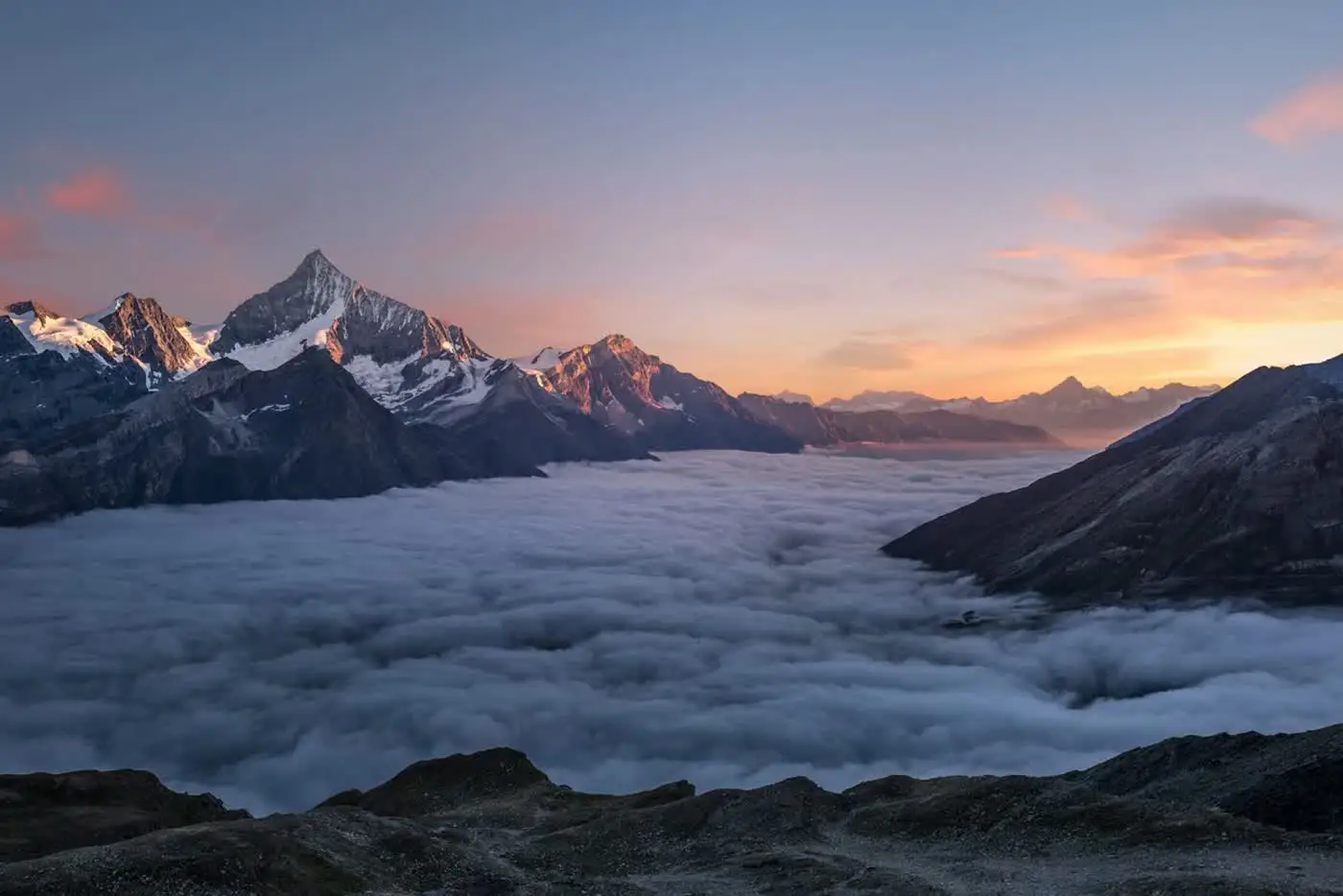
An hour from the Promenade des Anglais, there is a place where you click into your skis while looking at the Mediterranean. That is not a figure of speech: Gréolières-les-Neiges is the closest ski resort to the Mediterranean coastline, roughly 21 km from the sea as the crow flies according to the Côte d’Azur France regional tourist board. This article is not a practical guide — it is an invitation to understand this improbable place, its geography, its panoramas and what it offers twelve months a year.
A geographical anomaly
On paper, none of it should work. Twenty kilometres from a warm sea, at the latitude of palm trees, snow has no business staying on the ground. It stays anyway, and the explanation lies entirely in the relief.
The resort sits between 1,400 and 1,800 m on the north face of the Cheiron massif. That orientation is the key: the south face, the one looking at the sea, takes the sun head-on; the north face stays in shade for much of the day in winter. It is there, on that sheltered reverse slope, that the ski area was laid out — more than 1,000 hectares in one continuous block.
Add to that the sheer steepness of the Riviera hinterland. In some thirty kilometres as the crow flies, you go from sea level to the 1,778 m of the Cime du Cheiron, the highest point of the Préalpes d’Azur. Few massifs anywhere offer such an abrupt gradient between beach and summit. It is this compression of space that makes possible an idea that would be absurd elsewhere: a ski area an hour from the coast.
The whole thing sits within the Préalpes d’Azur Regional Nature Park, a landscape of limestone, pastoral plateaux and gorges that forms the transition between the hinterland of Nice and the first high mountains.
The Cheiron, a mountain that overlooks the sea
The Cheiron massif has a rare quality: it overlooks both the Mediterranean and the Loup gorges. On one side the blue void, on the other the limestone gash carved by the river.
From the pistes, and even more from the Cime du Cheiron (1,778 m) with its three orientation tables, the panorama covers:
- The coastline from Saint-Tropez to Monaco — very nearly the whole of the French Riviera in a single glance.
- The Mercantour massif to the north, with the Cime du Gélas topping out at 3,143 m.
- Corsica, visible on very clear days, sitting on the horizon.
It is this triple panorama, far more than any statistic, that makes the place singular. Skiing with the sea in view, then turning around to face summits over 3,000 metres, is not something you get to do in many places. Our article on the most beautiful viewpoints around Gréolières details the best spots.
A village below, a resort above
The name often causes confusion. Gréolières is a hilltop village at around 830 m, clinging to its promontory in the valley. Gréolières-les-Neiges is the resort, six hundred metres higher, on the other side of the massif. The two are joined by the road over the pass — a change in altitude that is enough, in winter, to shift from Mediterranean to Alpine scenery in a handful of kilometres.
The resort has been run since 2004 by the SMGA, the joint authority for the Gréolières and Audibergue resorts, a public body that also administers the neighbouring Audibergue-La Moulière resort.
Winter: a fuller ski area than it looks
The “small family resort” reputation is misleading. The alpine area offers around 30 km of runs served by 11 lifts: one 4-seat chairlift (the Huskies), 8 drag lifts, a magic carpet and a second carpet in the ESF snow garden.
The breakdown of the runs often surprises people: 4 green, several blue, a majority of red and 2 black. In other words, an area whose core is aimed at confident skiers, paired with a beginners’ zone right on the snow front and a snowpark. 76 snow cannons cover 4 km of runs, securing snow cover on the strategic sectors. The season runs from roughly 20 December to early March.
But the real pride of the place lies elsewhere: its 30 km Nordic area, laid out between 1,400 and 1,540 m, is the largest in the Alpes-Maritimes. On these high plateaux, cross-country skiing takes on a particular quality — silence, forest, glimpses out towards the sea horizon. There are also waymarked snowshoe itineraries and sledging runs.
Summer: the massif changes its face, not its purpose
When the snow melts, the area does not close, it converts. Gréolières-les-Neiges is one of the 6 entry points of the FFC-labelled “VTT Parc des Monts d’Azur”, which totals 31 routes and 390 km.
On site, 7 waymarked mountain bike loops numbered 10 to 16 add up to more than 60 km, all starting from the Maison du Fondeur and all open to electric mountain bikes. Number 16, graded black, climbs to the Cime du Cheiron — the same view as in winter, without the skis. The Huskies chairlift opens to bikes in summer, and an enduro track rounds out the offer. The routes are described in our guide to the MTB trails, and electric mountain bikes are rented on site.
Hiking: the peonies and the Cime du Cheiron
On the walking side, two itineraries sum up the massif well:
- The Grande Boucle des Pivoines (Great Peony Loop) — 7 km, +200 m of ascent, about 2 hr 15. Its distinguishing feature: wild peonies, a protected species, flower there from late April to mid-June. A short bloom that draws the curious every spring; we have devoted an article to it.
- The Cime du Cheiron via the GR4 — 8.4 km return, +504 m, around 4 hr. This is the route that leads to the three orientation tables and the full panorama.
Add the Gréo’Luge, a year-round rail sledge (1 km of descent, up to 40 km/h, from age 3 when accompanied), and the Gréo’Parc for children. The site is therefore as alive in July as in February, which remains rare for a resort of this size.
What makes the place unique
Let us sum up what you will not find anywhere else:
- Proximity to the sea: no resort is closer to the Mediterranean coastline.
- The view: Saint-Tropez to Monaco on one side, the Mercantour and Corsica on the other.
- The contrast: six hundred metres of altitude separate a perched Provençal village from a ski area.
- The Nordic area: the largest cross-country skiing domain in the department.
- The continuity: the same massif hosts skiers in winter and mountain bikers in summer.
It is not the highest resort in the Alpes-Maritimes, nor the largest. It is the only one whose geography tells you something: the exact point where the Mediterranean and the mountains face each other. If you are now wondering how to get up there and how long it takes, our access guide from Nice, Cannes and Antibes gives every journey, town by town.