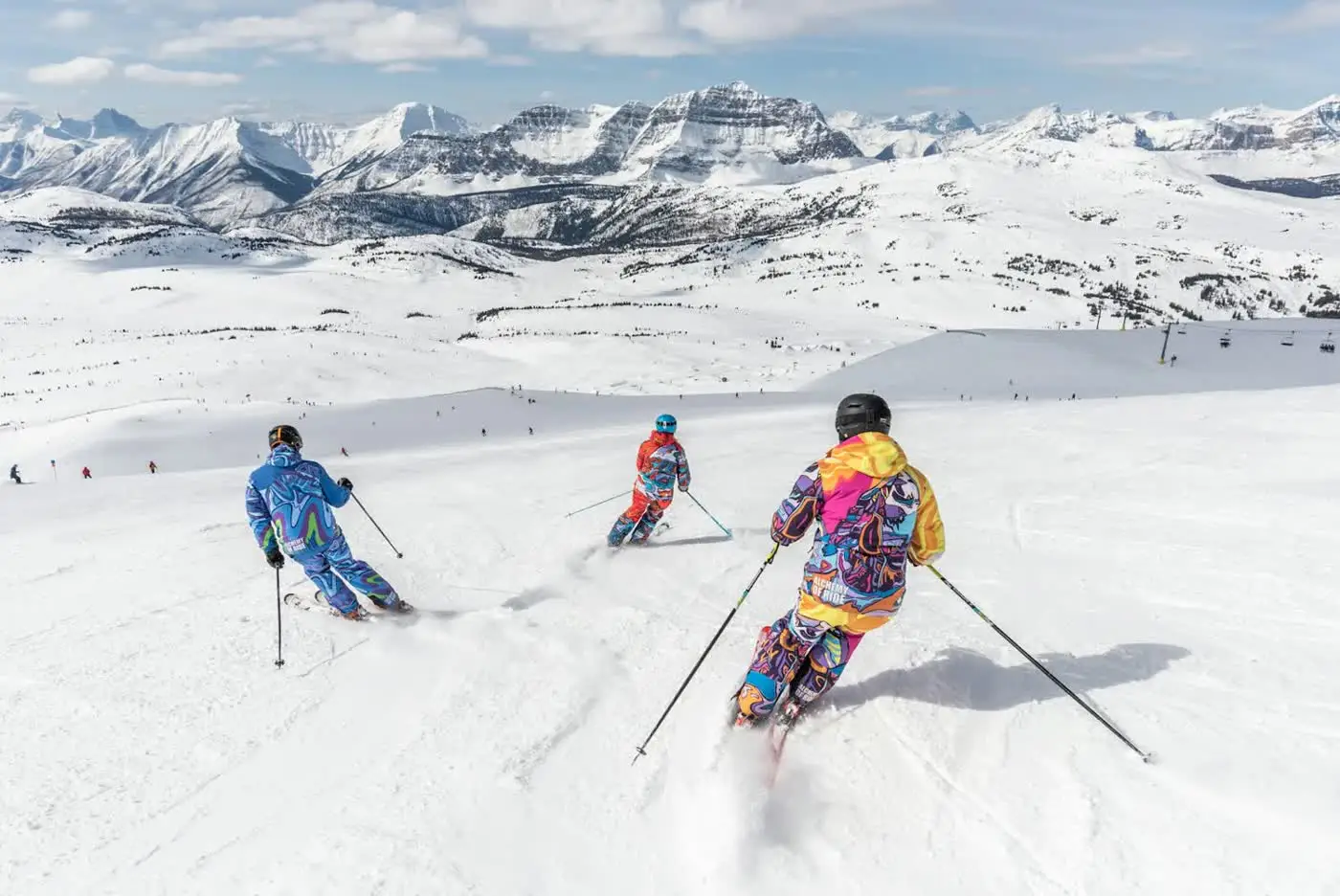
Gear doesn’t make the skier, but bad gear can ruin a whole day. Boots that are too big, skis too long for a beginner, a child with cold hands: these are the three most common causes of a day cut short. Well-chosen equipment, on the other hand, disappears — which is exactly what you want from it.
Here are the benchmarks we use at the counter, at 310 Traverse du Cheiron, to kit out skiers in Gréolières-les-Neiges.
Start with the right question: what’s your plan?
Before talking length or stiffness, answer three questions.
- How many days will you ski this season? One or two weekends a year doesn’t justify buying: renting gives you access to serviced equipment, with no storage or upkeep.
- What’s your real level? Not what it was ten years ago, but what you can actually do on a red run today.
- Who’s skiing with you? A family day with a 4-year-old doesn’t call for the same gear as an outing between confident adults.
At Gréolières, the area has around 30 km of runs between 1,400 and 1,800 m: 4 green, several blue, a majority of red and 2 black. Enough to progress, but also enough to end up on too steep a slope with ill-suited gear.
Ski or snowboard?
Skiing remains the best entry point for beginners and children: the legs are independent, balance is more natural, and the snowplough gives you a way to control your speed almost immediately. A beginner can hope to ski down a green run by the end of day one.
Snowboarding demands more patience. The first two days are thankless — plenty of falls on your backside and wrists — because you have to learn to move with both feet fixed to one board. Past that point, progress is often faster.
Practical benchmarks:
- Under 8: skiing, without hesitation. Snowboarding needs strength and coordination most young children don’t yet have.
- An adult who only skis once a year: skiing lets you enjoy it from day one.
- Already ride a board (skateboard, surf, wakeboard): snowboarding will need far less adaptation.
Either way, a lesson changes everything: see our article on ski lessons in Gréolières.
What ski length should you choose?
This is the most common question at the counter. The general rule, for all-round alpine skis:
- Beginner: skis that reach between your chin and nose. Shorter skis turn easily and forgive mistakes.
- Intermediate: between your nose and the top of your head. A good compromise between manoeuvrability and stability.
- Advanced: your own height, to a few centimetres above. Longer means more stable at speed, but more demanding.
Two adjustments to apply:
- A skier heavy for their height can go a few centimetres longer; a light skier, a few centimetres shorter. The ski flexes under weight, which is what makes it turn.
- A shorter ski isn’t a kid’s ski, it’s a more forgiving ski. Many adults progress faster with 5 cm less than expected.
For children, the reference is simple: skis that reach the chin. Don’t buy “a size up for next year”: a child on skis that are too long can’t turn them and gives up.
Boots: the piece that really matters
If you only get one thing right, make it this. The boot transmits every movement of the leg to the ski, and it’s the one that ruins a day when badly chosen.
How to check a boot in the shop
- One pair of ski socks only, thin and long, with no seam over the toes. Two layered pairs cut circulation and leave you cold.
- Standing, legs straight: your toes should just brush the front of the shell.
- Flex your knees forward: the foot slides back slightly, the toes clear the front. That’s the sign to look for.
- The heel shouldn’t lift when you flex. If it does, the boot is too big.
- Stay in it for five minutes. Discomfort at five minutes becomes pain at two hours.
On stiffness, a beginner needs a soft, comfortable boot, not a racing shell: stiffness only adds precision once you’re skiing fast enough to need it. For children, prioritise comfort. A child with sore feet won’t always say so clearly — they’ll just say they want to go in.
Poles, bindings and settings
Poles help set the rhythm of a turn and give you a push on flat sections. Right length: elbow at 90° with the tip on the ground, grip in hand. Many instructors prefer to start without them, so beginners don’t lean on them.
Bindings must be set on every rental. The setting — often called the DIN index — depends on four parameters (weight, height, age and level) plus boot sole length. It determines the force at which the ski releases in a fall.
Two safety rules:
- Never ask for a tighter setting “so it doesn’t release.” A ski that won’t release transmits the twist to the knee instead.
- Give your real weight and level. Overstating your level skews the setting in the wrong direction.
If you swap boots partway through your stay, come back and see us: the bindings need re-adjusting.
Full pack or à la carte rental?
For most skiers, the full pack is the simplest and most economical option: everything is set up together and returned together. Our day rates on the ski and snowboard rental page:
Alpine skiing
- Skis only: €13 child / €20 adult
- Boots only: €10 child / €15 adult
- Poles: €4 child / €5 adult
- Full Alpine Pack: €17 child / €25 to €28 adult, helmet included for adults
Snowboard
- Board only: €15 child / €20 adult
- Boots: €10 child / €12 adult
- Full Pack: €20 child / €25 adult
Do the maths: for an adult, skis + boots + poles rented separately come to €40, versus €25 to €28 as a pack. Item-by-item rental only makes sense if you already own part of your gear — typically your boots. We also rent snowshoes at €11 and sledges at €10 each.
Helmet and protection
The helmet is included in the adult full packs. For children, ask us at the counter or by phone: we’ll confirm what’s included in your pack.
A few benchmarks:
- The helmet should stay put without the chin strap fastened. If it moves when you shake your head, it’s too big.
- Nothing between the helmet and your head: no thick hat, no hood.
- Goggles rather than sunglasses as soon as it’s snowing or windy, with a clear lens for overcast days.
- In snowboarding, wrist guards are the single most useful accessory in the first few days.
What people always forget
Ski gear is only half the equation; the rest is about what you wear:
- Three layers: technical base layer (never cotton), fleece, and a waterproof, breathable jacket.
- Waterproof gloves — for young children, mittens, which are warmer and easier to put on.
- One dry pair of ski socks per day.
- High-SPF sunscreen. At 1,800 m, sunburn happens even under cloud.
- Water. Cold masks thirst, but exertion still dehydrates you.
Picking up and returning your gear
We’re at the foot of the slopes, 310 Traverse du Cheiron, open 7 days a week from 9 am to 5 pm. The resort car park is free (2,800 spaces). A few tips for the logistics:
- Come the evening before or early in the morning. The 9–10 am slots during school holidays are the busiest.
- A call to +33 6 21 45 80 87 during holiday periods lets us prepare your gear in advance. You can also just walk into the shop without booking.
- For a multi-day stay or a group, call us: we don’t have a published multi-day grid, but we’re happy to talk it through — or write to us via the contact page.
- Report any problem immediately. A boot that hurts is fixed in five minutes at the counter; a wasted half-day can’t be recovered.
And finally, think about the rest of the day. After two hours of skiing, plenty of children would rather have a sledging session or the Gréo Parc than a third run down.